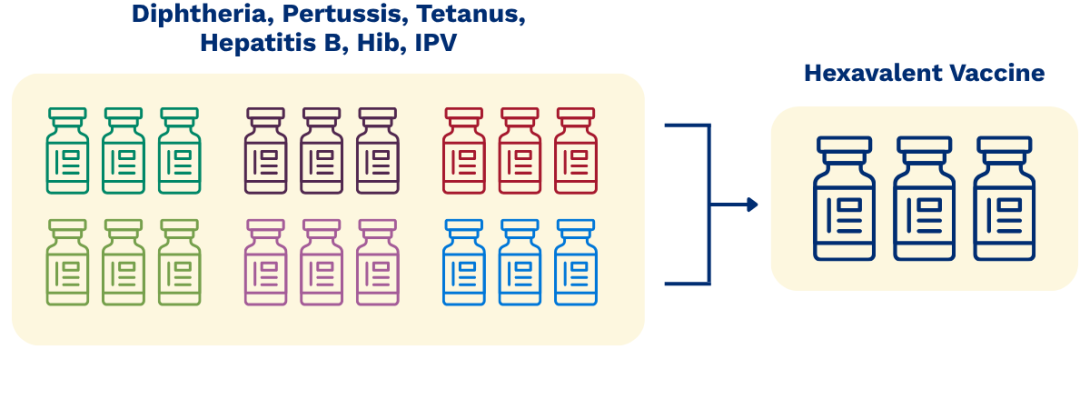
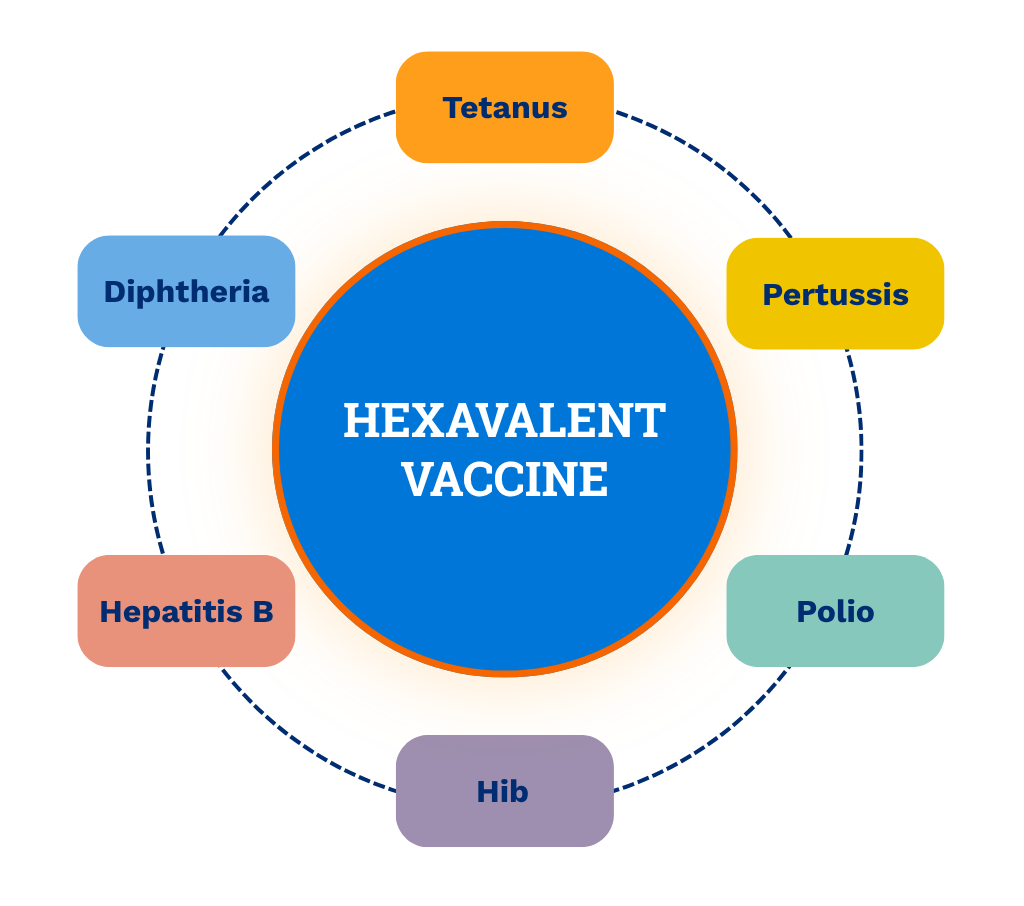
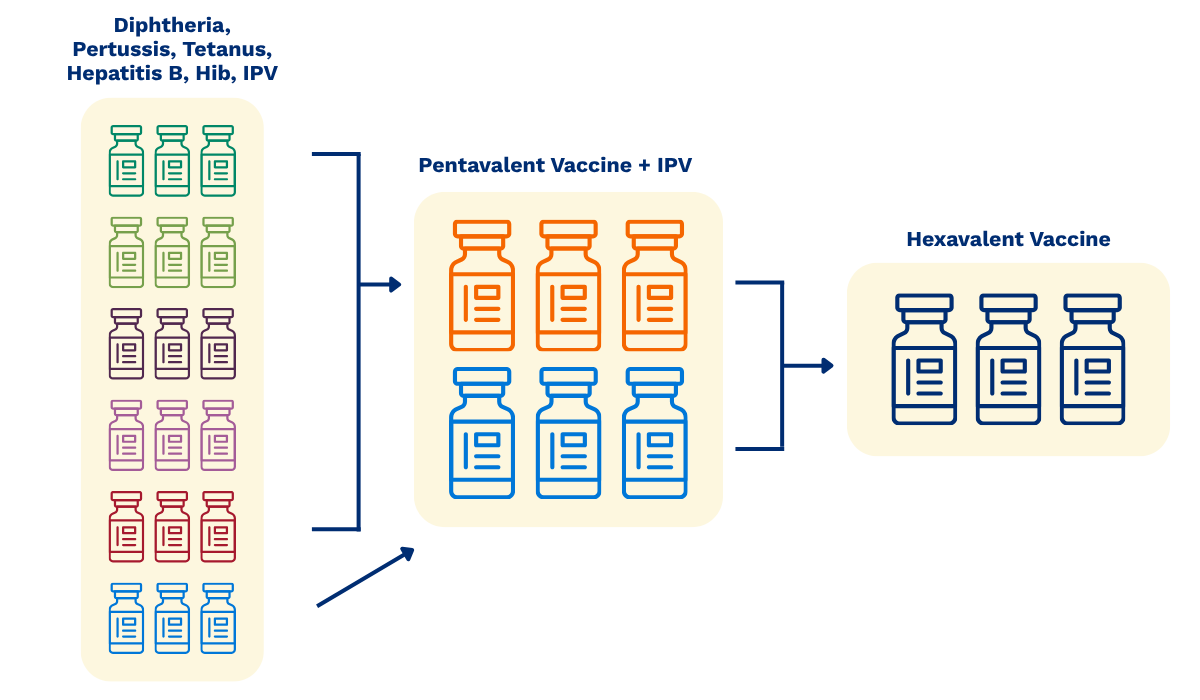
The hexavalent vaccine—a six-in-one vaccine that protects children against diphtheria, tetanus, pertussis, hepatitis B, Haemophilus influenzae type b (Hib), and polio—represents an opportunity to expand polio vaccination coverage to reach un- and under-vaccinated children while optimizing immunization programs by halving the number of injections required by programs using pentavalent plus inactivated polio vaccines (IPV).
The first hexavalent vaccine, containing acellular pertussis (aP), was prequalified in 2004 and has been implemented in high-income countries like Australia and the United Kingdom for decades. In 2024, the World Health Organization prequalified Hexasiil, a new hexavalent vaccine manufactured by the Serum Institute of India which includes a whole-cell pertussis (wP) component. Many countries previously relied on wP-containing pentavalent vaccines, in part because wP triggers more durable immune responses. Following Hexasiil’s prequalification, these countries now have the option to switch to these six-in-one vaccines.
The latest Gavi funding guidelines allow eligible countries to either switch to three doses of the wP hexavalent vaccines or continue using the pentavalent vaccine plus IPV as part of their guaranteed program budget, which is expected to facilitate the introduction of hexavalent vaccine in the coming years. This switch would allow countries to simplify their childhood immunization schedules while simultaneously strengthening their polio vaccination programs.
Current Use and Real-World Evidence
As of September 2026, 74 (38%) countries are using hexavalent vaccines (aP or wP) in their national programs. More than one-third of these launches have occurred in just the last six years: Of the 57 countries with a known introduction date, 15 countries switched to hexavalent vaccines between 2000 and 2010, 19 countries switched between 2010 and 2020, and 23 countries have switched since 2020. The majority of countries using hexavalent vaccines are high-income (44, or 59%) or upper-middle-income countries (26, or 35%). Just four lower-middle-income countries (5%) are using these vaccines to date, and they have yet to be introduced in a low-income country. Just two Gavi-eligible countries (Mauritania and Senegal) have introduced hexavalent vaccines, though this number is expected to increase with their inclusion in Gavi’s latest funding guidelines. Of the 17 former Gavi-eligible countries, five (Armenia, Azerbaijan, Georgia, Honduras, and Indonesia) have introduced hexavalent vaccines.
In countries that have include hexavalent vaccines in their national immunization programs, most countries (62, or 84%) use aP vaccines, most of which are high-income countries (43). Just 10 countries (14%) currently use wP vaccines, seven of which are upper-middle-income. Both Gavi-eligible countries that have introduced hexavalent vaccines are using the wP formulation.
Mauritania and Senegal provide important lessons and real-world evidence to help inform other Gavi-eligible countries as they consider switching to hexavalent vaccines [1]. In both countries, national governance, program management, and immunization systems, and the maturity of these, played a role in the decision-making around hexavalent vaccine introduction, although the countries had different experiences. Senegal’s well-established and well-functioning governance and immunization systems, including its Inter-agency Coordination Committees for Immunization and national immunization technical advisory group (NITAG), ensured a smooth and timely path from policy to introduction. In Mauritania, less institutionalized governance and lack of inclusive planning led to early gaps in communication between different levels of governance, which ultimately slowed down the initial rollout of vaccines. Mauritania and Senegal both added the hexavalent vaccine to their national immunization programs in July 2025.
In Mauritania, hexavalent coverage was inconsistent upon introduction, with coverage varying widely across urban, rural, and hard-to-reach areas. Other factors impacting coverage included access, staffing, and community engagement. First-dose coverage of hexavalent vaccine generally aligned with pentavalent coverage, but third-dose coverage was lower and more variable, corresponding with historical seasonal declines during the country’s rainy season. Mauritania’s early experiences highlight the importance of including local factors in immunization planning to optimize coverage.
In Senegal, a country with strong routine immunization performance prior to the switch, hexavalent coverage was consistent with pentavalent coverage across both locations and doses. There was no evidence that the switch created disparities between urban, rural, or hard-to-reach areas, and first-dose and third-dose coverage of the hexavalent vaccine remained high during the early post-introduction period. Senegal’s early experiences indicate how a well-functioning immunization system can support the switch to hexavalent vaccine.
Vaccination Schedule
The WHO recommends a three-dose series for the wP hexavalent vaccine, beginning at 6 weeks and with at least 4 weeks between doses. WHO’s Strategic Advisory Group of Experts on Immunization (SAGE) initially recommended a four-dose series when the first dose was administered to infants younger than 8 weeks old, but updated immunogenicity evidence illustrated that a fourth dose provided only a small incremental benefit that was outweighed by the complexity and costs of administering an additional dose. As the wP hexavalent vaccine contains IPV but not bivalent oral polio vaccine (bOPV), countries that switch to hexavalent will still need to include bOPV in their immunization schedules to optimize polio protection.
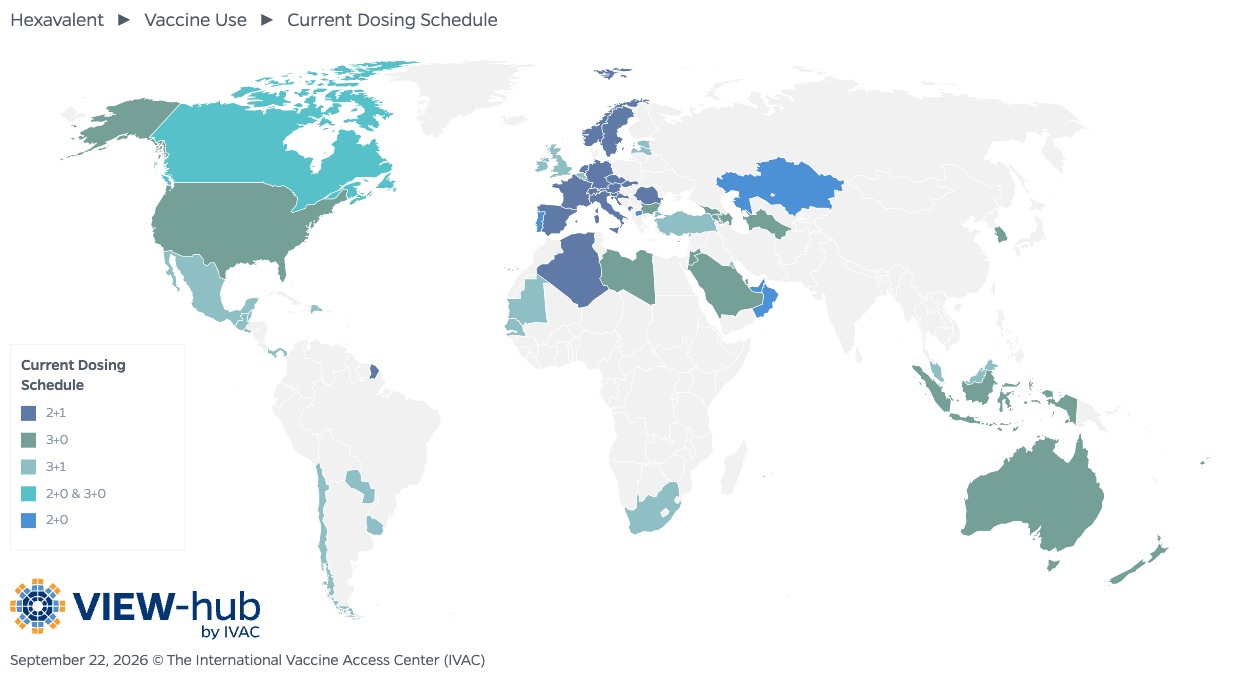
As of September 2026, 40 (54%) of the 74 countries that have introduced hexavalent vaccines use a 3-dose schedule. This includes 60% (37) of the 62 countries using aP hexavalent vaccine and 30% (3) of the 10 countries using wP hexavalent vaccine. Of the 40 countries on a 3-dose schedule, 20 use a 2+1 schedule with two primary doses and a booster dose, and 20 use a 3+0 schedule with three primary doses and no booster dose. While more than half of countries have adopted a 3-dose schedule, 27 countries (36%) still use a 4-dose schedule and a few countries administer just two doses of the hexavalent vaccine in conjunction with two doses of a pentavalent vaccine.
Increasing Program Efficiency and Strengthening Polio Vaccination
Hexavalent vaccines provide similar benefits to other combination vaccines, including increased program efficiency and fewer injections. An added benefit for these vaccines is the potential to strengthen polio vaccination efforts.
Switching to the hexavalent vaccine would continue to protect children against all six diseases with half the number of injections (three versus the six required with pentavalent plus IPV), which is appealing to both caregivers and health care workers [1]. Combining two vaccines into one product also requires less cold chain storage and fewer vaccination supplies, such as syringes.
Hexavalent vaccine introduction is expected to produce cost savings in certain contexts, depending on the price of the vaccine. For example, an economic analysis in India estimated that switching to the wP hexavalent vaccine would save approximately INR 9,187 million (approximately US$ 95.9 million), driven by reductions in syringes, cold chain requirements, and staff time [2]. However, the high procurement price of hexavalent vaccine would more than offset these cost savings. An assessment in Peru on switching to the aP hexavalent vaccine had similar findings: Introducing the hexavalent vaccine into the national immunization program would reduce logistical costs but increase acquisition costs [3]. With its recent inclusion in the Gavi vaccine portfolio, the price of the wP hexavalent vaccine per dose is projected to decline as the market matures, greatly increasing the cost-effectiveness of these vaccines [4].
Beyond these programmatic advantages, the introduction of hexavalent vaccines is also expected to increase protection against polio. According to 2025 WUENIC data, 36 (18%) countries (including 23 Gavi-eligible countries) had first-dose IPV coverage of less than 80%. Second-dose coverage lags even further behind, with 55 (33%) countries (including 32 Gavi-eligible countries) having less than 80% coverage in 2025. As coverage with diphtheria, tetanus, and pertussis (DTP)-containing vaccines (such as pentavalent vaccines) is generally much higher, with 2025 global coverage of the first dose of these vaccines at 90%, combining IPV with DTP-containing vaccines such as hexavalent vaccines will hopefully strengthen polio eradication efforts.
Key Takeaways
-
Though high-income countries have used hexavalent vaccines containing acellular pertussis for decades, Gavi-eligible countries now have access to these important combination vaccines thanks to a newly prequalified hexavalent vaccine with a whole-cell pertussis component and updates to Gavi funding guidelines.
-
By combining six vaccines into one, hexavalent vaccines reduce the number of injections while still protecting against disease, increasing programmatic efficiency and supporting acceptability.
-
As pentavalent vaccines generally reach more children than inactivated polio vaccines, combining the two is an opportunity to strengthen polio vaccination efforts and reach more children with fewer resources.
Additional Resources
Sabin Vaccine Institute and The Partnership for International Vaccine Initiatives (PIVI) at The Task Force for Global Health have created a variety of resources as countries consider switching to hexavalent vaccines, some of which are linked below.
Hexavalent Vaccine (Switch) Assessment Consortium (HeVAC) [Sabin]
Accelerating Evidence-Informed Vaccine Introductions: Lessons from the Hexavalent Early Adopters Workshop [PubMed / Sabin]
Optimizing Decision-making, Implementation, and Monitoring to Maximize the Impact of the Transition from Pentavalent + IPV to Hexavalent Vaccine in Mauritania [Vaccine X / Sabin]
Insights from the Hexavalent Switch: A Process Point Risk Mitigation Compendium (includes health system adaptation checklist and Gavi co-financing and sustainable financing FAQ) [Sabin]
References
-
Hopkins KL, Ndiaye S, Abdullah ZS, Atugonza R, Badiane O, et al. Accelerating evidence-informed vaccine introductions: Lessons from the Hexavalent Early Adopters Workshop. Vaccines (Basel). 2026;14(5):452. doi:10.3390/vaccines14050452
-
Kumar P, Singh K, Ray A, Kumari A, Chatterjee S, et al. Economic implications of switching to the hexavalent infant vaccine in an immunization program in India. Hum Vaccin Immunother. 2026;22(1). doi:10.1080/21645515.2026.2676400
-
Seinfeld J, Rosales ML, Sobrevilla A, López Yescas JG. Economic assessment of incorporating the hexavalent vaccine as part of the national immunization program of Peru. BMC Health Serv Res. 2022;22(1):651. doi:10.1186/s12913-022-08006-1
-
Gavi, the Vaccine Alliance. Hexavalent vaccine programme information. Gavi, the Vaccine Alliance. Accessed September 11, 2026. https://www.gavi.org/our-support/guidelines/hexavalent-vaccine-programme-information